

 Pau Coderch
In this article+
In 30 seconds
- 01Adding the restaurant takes an afternoon; Google’s review, up to 5 working days.
- 02After that come daily, weekly and monthly tasks. Google states that complete and accurate information is more likely to show up in local searches.
- 03An owner can do it alone if they are consistent. If not, automate or delegate.
Why Google Maps decides who fills up
When someone wants to eat out, they open Google Maps and type "restaurant near me" or "menú del día in my neighbourhood" (the menú del día is the fixed-price set lunch that Spanish restaurants change every day). Google shows them the nearby places that fit best, with rating, photos, opening hours and buttons to call or get directions. Your listing is not a formality: it is the channel your next customers arrive through.
Google ranks those results by relevance, distance and prominence. Prominence is how well known the venue is: reviews, ratings and websites that talk about you. This guide follows the order in which the work is done: prepare the account, add, verify, set up and maintain.
Before you start: the account and who has access
Create the listing with a Google account that belongs to the business, not the personal one of a waiter who will leave in the summer.
It can use the restaurant’s email address; Gmail is not required. Turn on two-step verification, as Google recommends.
If someone else is going to work on the listing, add them as a manager instead of sharing the password. Owners can transfer the listing, so keep that role for yourself or your business partner. When someone leaves the restaurant, remove their access that day.
Be wary of anyone who phones claiming to be from Google and offers to improve your listing for money. Business Profile is free, and Google will never ask you for a one-time code or a payment to verify or maintain the listing.
Adding the restaurant to Google Maps step by step
Before you create anything, search for your venue on Maps: there may already be a listing created by Google or by a customer.
If there is, do not create another. Google only allows one profile per business and hides the one it considers a duplicate.
The name has to be the one on your sign, the way customers know you. Google can suspend the listing if you add slogans, the neighbourhood or what you serve to the name.
- Search for the venue on Maps. If there is already a pin, press "Claim this business" and then "Manage now".
- If you see "This Business Profile might be managed by someone else", press "Request access". The current owner has 3 days to respond.
- If there is no pin, go to business.google.com/add and press "Add your business to Google".
- Real name, specific category and exact address with the street number.
- A phone number the venue controls, the one that gets answered during service.
- Website if you have one. If not, leave it empty: Google does not accept a social media page in its place.
Verifying the listing: video, phone or postcard
According to Google, only verified businesses can show their information on Maps and in Search.
Google decides which methods it offers you (video, phone or text message, email, video call or postcard) depending on the type of business, the area or the opening hours, and they cannot be changed. If it offers you video, that is the one it recommends.
The video is recorded live from your phone, inside the listing: a single continuous take, unedited and at least 30 seconds long. The name visible on the sign has to match the one on the listing. It has to show this:
- Where you are: the street sign, the street number or the businesses next door.
- That the venue exists: the front with its permanent sign, and the inside.
- That you run it: the kitchen, the till, the storeroom or the TPV (the point-of-sale system).
- No faces of customers or employees, and no bank or tax details.
- Review: up to 5 working days. By postcard, most codes arrive within 14 days and expire after 30; while you wait, do not change the name, address or category.
The key point
Adding the restaurant takes an afternoon; Google’s review, up to 5 working days.
Setting up the details that always have to be up to date
The primary category is the most important decision: Google asks for the most specific one that describes your main activity.
Plain "Restaurant" puts you in competition with everyone; your type of cuisine or venue is better. You can add up to 9 more, only the ones that are true and never as keywords.
For the main opening hours, Google asks for the period when customers can sit down to eat. Takeaway or delivery go in the full hours, and public holidays in special hours. The description allows up to 750 characters, with no links or promotions: what you cook, in which neighbourhood and which dishes.
Swipe to compare →
| Field | What to put | Common mistake |
|---|---|---|
| Primary category | The most specific one that describes you | Plain "Restaurant" |
| Additional categories | Up to 9, all true | None, or used as keywords |
| Opening hours | Sit-down dining hours, with public holidays in special hours | The ones from opening day, never touched |
| Phone | One the venue controls; two more are allowed | The previous owner’s personal mobile |
| Website and menu | Your own website and the menu as text | A link to Instagram or to a delivery platform |
| Description | Cuisine, neighbourhood, dishes, menú del día | "Quality cooking and a welcoming atmosphere" |
| Attributes | Terrace, bookings, children, accessible, vegan | Empty |
| Bookings | Reserve button with a Google partner | No button or a broken link |
Photos: a weekly rhythm, not once and done
Google includes adding photos and videos among its tips for improving local ranking.
A photo shows what you serve better than any description and helps the customer decide before they come.
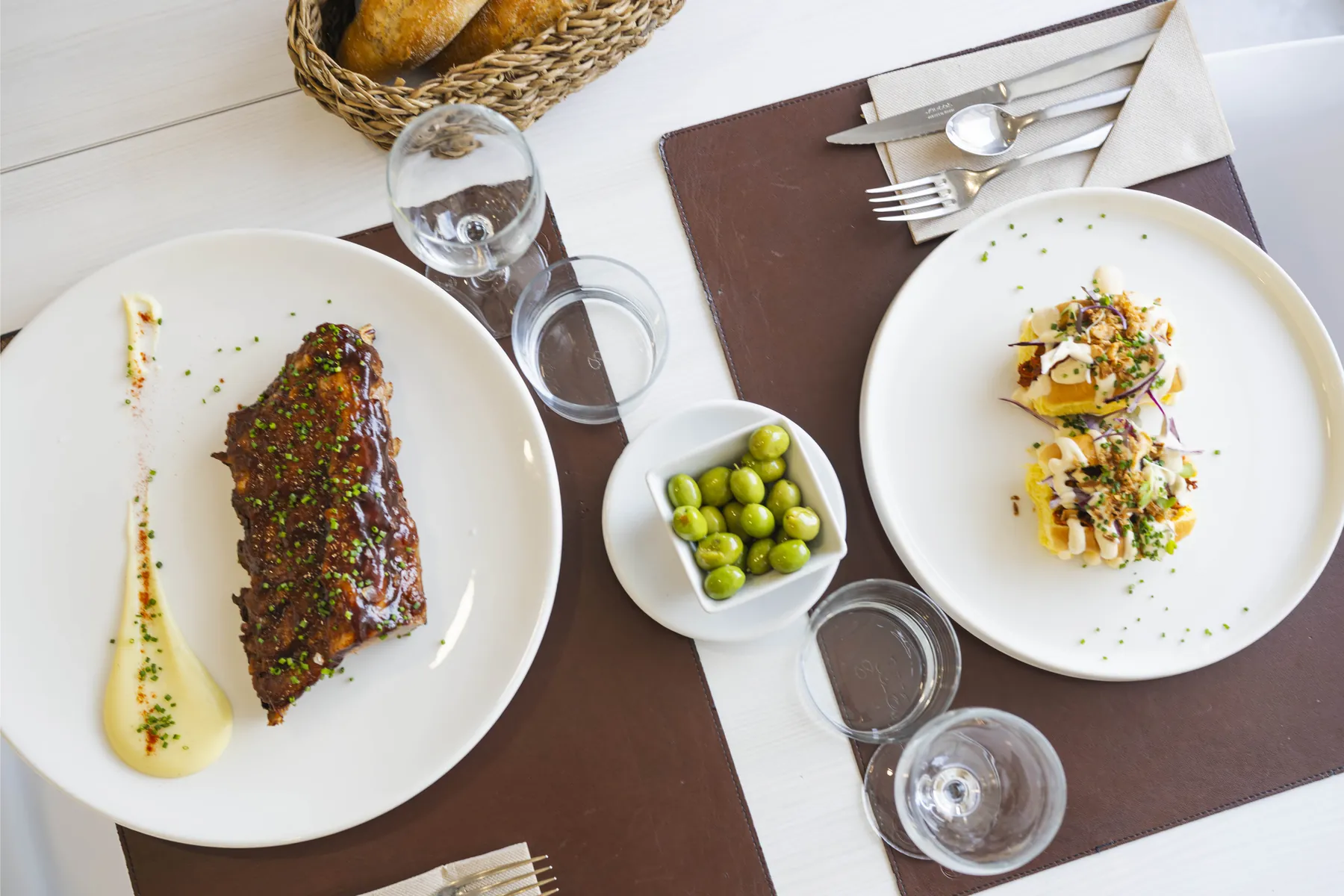
To start with: dishes, dining room, terrace, team and a shopfront people can recognise when they arrive. After that, new photos on a regular basis, in natural light and with no stock images. The guide to photos for Google Maps has the types, the quantities and the rhythm.

The menú del día: the job for every morning
The menú del día changes every day, and updating it by hand on the listing, the website, the table menu and Instagram takes time you do not have at ten in the morning.
That is why it is the first thing people stop publishing.
On the listing, its place is a post of the "Update" type: text, photo and a button with a link, visible in the "Updates" tab on Maps. Do not put phone numbers in the text, because Google may reject the post. If you are not going to keep it up by hand, automate it.
How Menuveo does it
With Menuveo you take a photo of the chalkboard and send it by WhatsApp; you check dishes, price and allergens, and the same menu is published on Google Maps, the website and the QR.

Posts: offers, events and the ones that repeat
Besides updates, the listing accepts offers, with a title, dates and a "View offer" button, and events, with a start and end day and time.
They work for the Christmas menu, a tasting or the opening of the terrace. Google reviews each post and tells you whether it is live, pending or not approved.
Two features save work: you can schedule a post for another day and make it repeat every week or every month. Posts older than six months are archived if you do not give them a date range, so the fixed ones do not last for ever.
Reviews: the invisible work of every week
Google explains that more reviews and positive ratings improve local ranking, and that replying shows you value the customer’s opinion.
A listing with reviews left unanswered for months looks abandoned.
Ask for them with the link or QR that the listing itself generates, in the bill folder or in a message the next day to whoever booked. Nothing in return: Google treats offering products or discounts for a review as fake engagement. Reply promptly, briefly and signing with your name, as Google advises.
How Menuveo does it
Menuveo alerts you to each review with a draft reply ready to approve from your phone, with the aim of answering all of them in under 24 hours.
The key point
After that come daily, weekly and monthly tasks. Google states that complete and accurate information is more likely to show up in local searches.
Bookings from Google: the button that saves phone calls
If your listing has the "Reserve" button, the customer books without leaving Google and without ringing a phone that is engaged in the middle of service.
You turn it on in the "Bookings" section of the profile, by choosing a Reserve with Google provider. Google states that it appears on the listing within a week.
Google warns that the provider may charge you for the bookings that come from Google, so ask about their model before you choose. You can also add your own link, but then Google does not give you performance data. Menuveo is on the public list of partners and charges no commission per booking.
The statistics: how to tell whether the listing is working
In "Performance" you see, for the period you choose, how people find you and what they do next.
It is only available on verified listings, and Google shows the metrics that apply to your business. The ones that say most about a restaurant:
- Searches: the terms people used to find you. Updated at the start of the month.
- Views: how many people saw the listing in Search and on Maps.
- Directions: how many asked how to get there.
- Calls and website clicks.
- Menus: clicks on your menu, its photos or its link.
- Bookings: the ones that come through a booking provider.
- Note down your figures every month and compare them with the same month of the previous year: August and January are nothing alike.
Maintaining the listing: what to do every day, week and month
Add up everything above and you get a task list that is hard to keep up with the restaurant open.
It is easy to start with energy and drop it after two months, and a listing that is not updated ends up with old information.
How Menuveo does it
Menuveo takes care of the tasks in this table and sends you the summary every month in Menuveo Studio. You stay in the kitchen.
Swipe to compare →
| Frequency | Task | Indicative time |
|---|---|---|
| Every day | Publish the menú del día on the listing, website and menu | 15-20 min by hand |
| Every day | Read and reply to new reviews | 10-30 min depending on volume |
| Every week | Upload one or two new photos | 15 min |
| Every week | One post (dish, terrace, event) | 10 min |
| Every week | Check whether Google has changed any details (shown in blue in the editor) | 5 min |
| Every month | Audit categories, opening hours, phone, links | 30 min |
| Every month | Review performance: searches, directions, calls, menu | 20 min |
| Every season | Summer or winter opening hours, public holidays, new menu | 30 min |
The three realistic options for a small restaurant
Doing it yourself is free and works if you give it time every day, including 15 August with a waiter off sick.
A local SEO agency charges, as a rough guide, several hundred euros a month; ask in writing whether that includes the daily menú del día and the reviews.
The third option is a service built for this. Menuveo maintains the listing, uploads photos, prepares the replies to reviews and publishes the menú del día from a photo. See the plan options under Pricing.
Frequently asked questions
Search for your venue on Maps: if it exists, claim it; if not, create it at business.google.com/add. Verify it with the method Google offers you and complete the category, opening hours and photos.
Google states that a new business can take up to a month to appear in the results, and it does not publish timescales for moving up.
Yes, Business Profile is free. What fails is the week-in, week-out consistency.
You stop doing something Google recommends for standing out. And the customer who reads unanswered reviews assumes you do not care about their opinion.
Initial optimisation, listing maintenance, photos, replies to reviews and publishing the menú del día from a photo. See the current options and terms under Pricing.
You give us access to the listing, we review it and get it into shape. After that you only let us know when something changes.